Communion With Jesus and the Liturgy Of the Hours

Nathan Budde • August 8, 2024

The Christian life is about communion with Jesus. I am reminded of this truth each day at the seminary in which our lives as seminarians are scheduled around liturgical and personal prayer. This is why the Church requires us to attend Mass every Sunday and encourages us to receive communion as often as possible (at least once during the Easter Season). At Mass we offer praise and thanksgiving to God for his goodness and the blessings he has given us. We also offer petitions for our own needs and the needs of the Church Universal. Most importantly, we offer our hearts during the Eucharistic prayer, joining our own intentions and offerings to the sacrificial offering of Jesus on the Cross and receive the Body, Blood, Soul, and Divinity of Jesus Christ who gives us divine life, and healing which conform our hearts and lives to look more like his. The source and summit of the Christian life, indeed, is the Eucharist. 


However, the Church’s liturgy does not end with Mass.


However, the Church’s liturgy does not end with Mass. The memorial of the Paschal Mystery, our communion with Jesus, and our offerings of praise, thanksgiving, and petition to the Father are extended throughout the day in the Liturgy of the Hours. This prayer is offered by the Church so that we are joined to Christ in prayer at all times and to sanctify the entirety of every day “from the rising of the sun to its setting” (Psalm 113:3).

Near the end of his public ministry on earth, Jesus instructed his disciple that “You must pray at all times and not lose heart” (Lk 18:1). In the Acts of the Apostles, we read that from the Church’s beginning, the apostles took Jesus’ command to “pray always” to heart by praying at fixed times throughout the day: the apostles were praying together on Pentecost during “the third hour of the day” (Acts 2:1-15); Peter “went up on the housetop to pray, about the sixth hour” (Acts 10:9); “Peter and John were going up to the temple at the hour of prayer, the ninth hour” (3:1); “about midnight Paul and Silas were praying and singing hymns to God” (16:25). Following the example of the Apostles, the Church gradually formalized this “hourly” personal prayer of the Early Christians into liturgical prayer which is called the Liturgy of the Hours or the Divine Office. Through the Liturgy of the Hours, the Church draws all of its members to “offer to God an unceasing sacrifice of praise” (Heb 15:15).


For those who pray the Office regularly, the Psalms begin to become part of the rhythm of life and a source of dialogue with God, both praying the psalms to the Father and also listening to how the word speaks to one’s own heart. 


The Liturgy of the Hours is made up of seven specified times of prayer (called “Hours”). The two most important hours, called the “hinge” hours, are Morning Prayer (prayed around sunrise or 6 am) and Evening Prayer (prayed around sunset or 6 pm). At the seminary, we pray both of these hours in community on most weekdays. The other hours are Office of Readings, the three Daytime Hours (Midmorning, Midday, and Midafternoon), and Night Prayer. Sanctifying specific times of the day, each Hour reflects a spiritual theme that correlates to the physical time of day. During the morning, for example, the prayers focus on resurrection and new life in Christ. During the evening, the prayers focus on thanksgiving for the day's blessings and preparation for the day ahead. For those who pray the Office regularly, the psalms begin to become part of the rhythm of life and a source of dialogue with God, both praying the Psalms to the Father and also listening to how the word speaks to one’s own heart. 

At their ordination, priests and deacons promise “to celebrate faithfully the Liturgy of the Hours”(1) for the glorification of God and sanctification of his people. While not required of the laity, the Second Vatican Council encouraged the entire Church, including the laity, to incorporate the Liturgy of the Hours into the liturgical life of parishes and individual Christians. 

The Liturgy of the Hours has been a significant part of my prayer life for several years. In the year or two before I entered seminary, I began to make Morning Prayer and Night Prayer a regular part of my prayer life. Since I did not have as much time to pray as I do now in seminary life, I found that committing to praying one or two Hours daily gave my prayer life stability. Being almost entirely scriptural, it helped me to become acquainted with Psalms and Scripture passages that I would not have otherwise prayed with or read at that time. Finally, it gave me a better sense of living a liturgical life, especially during the seasons of Lent, Easter, Advent, and Christmas.

If you are struggling to enter into a routine of prayer in your family life, if you would like to live more liturgically, or if you would like to pray more with Scripture, I encourage you to try incorporating one or more of the Hours into your daily prayer routine. A very simple start is to end the day with Night Prayer, which is simple to learn. While you can purchase a volume of Night Prayer or Christian Prayer (which contains Morning, Evening, and Night Prayer), there are many apps for iPhone and Android that prepare all of the prayers for you (no need to worry about ribbons or purchase an expensive book). Two very easy to use apps are the Divine Office and IBreviary apps. I encourage you to make a plan to pray one or two hours regularly by yourself or with your family. If we do not make plans for prayer, it will never seem like there is time for it. Making a commitment to pray Morning Prayer to sanctify the day as it begins or Night Prayer as a prayerful reflection on how the day went before going to bed is a great step toward prioritizing your prayer life and remaining in communion and conversation with Jesus each and every day. 

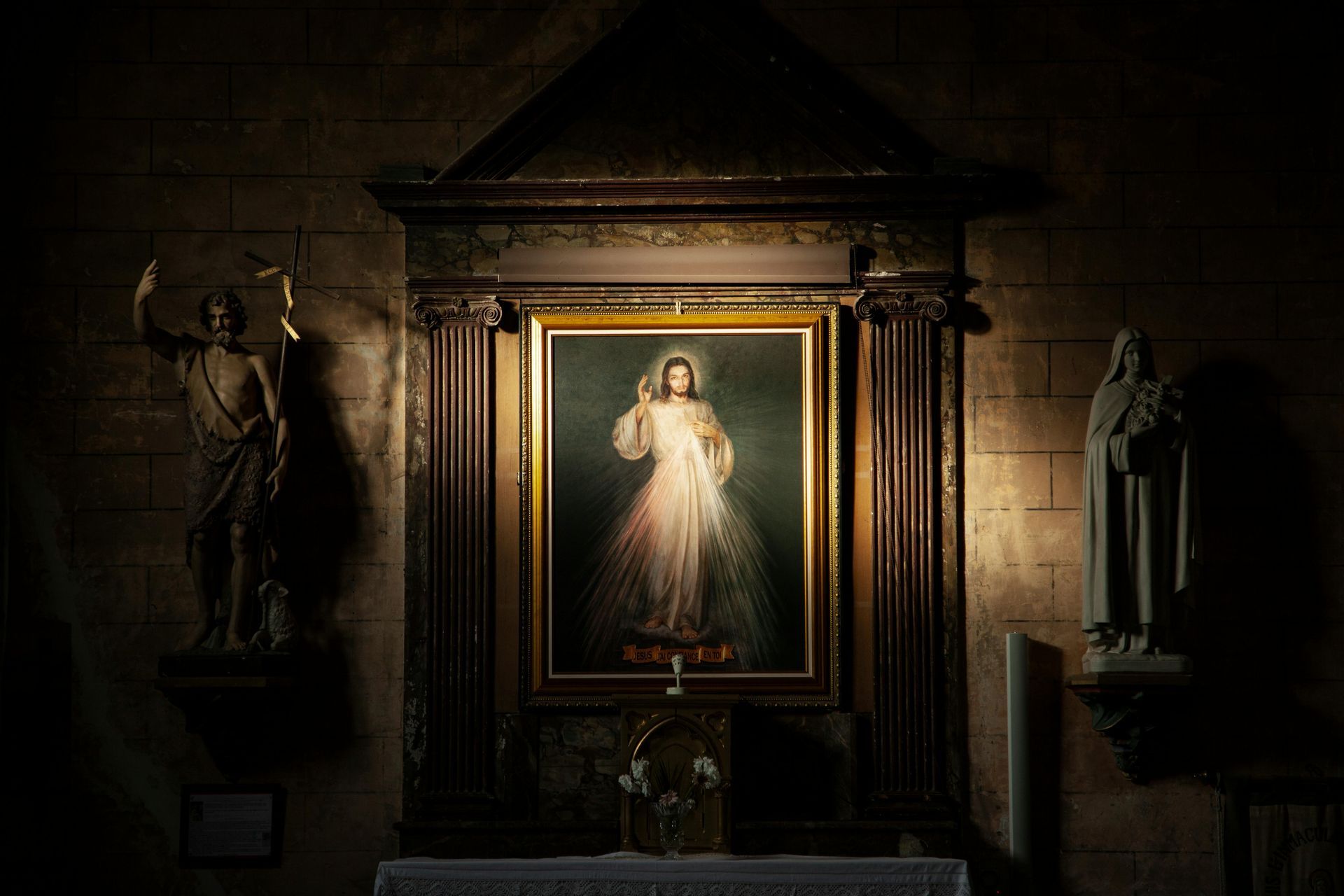
Please consider joining us at St. Leonard every fourth Saturday of the month after the 5 p.m. Mass for Evening Prayer in the Divine Mercy Chapel, beginning January 27.


(1) Ordination of Deacons – Promise of the Elect
April 9, 2026
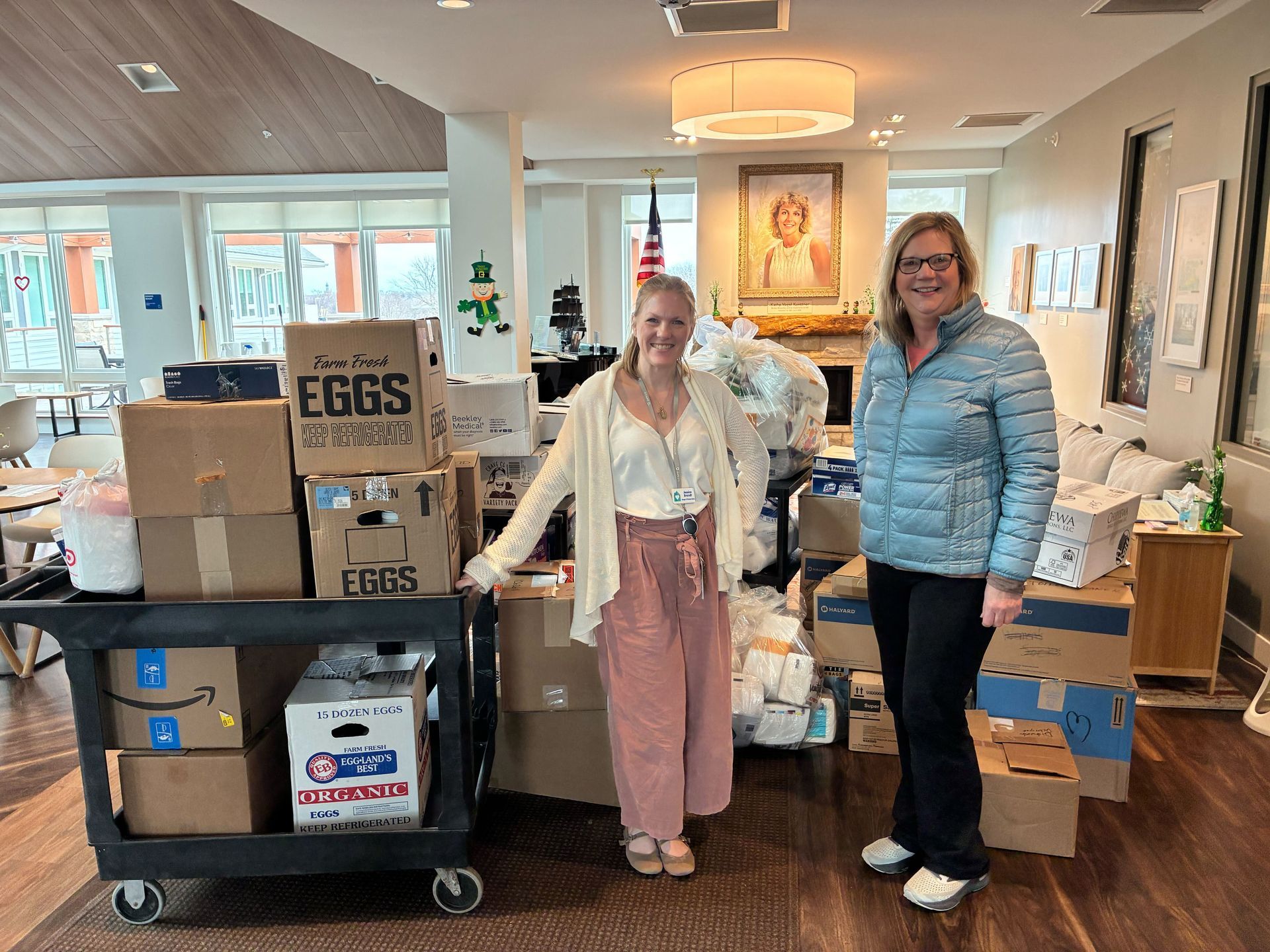
The Human Concerns Committee's Lenten and Easter collections were a great success, thanks to the generosity of our faith community. Through the Lenten collections we helped 5 organizations: The HOPE Center , Community Smiles Dental , Kathy's House , The Women’s Center and Street Angels . In addition to the items sent directly to the organizations through their Amazon wish lists, we donated 30-45 packed boxes/bags each week. The organizations themselves also thank you, with comments including the following: “Thank you for coordinating this effort! We are so thankful for everything. It will definitely be put to good use in the house,” (Kathy’s House). “We want to say how grateful (and still surprised) we are! So many children and families will benefit from this. It truly is an amazing thing your congregation does to help the community,” (Community Smiles Dental). Through the Easter Food Collection, we were able to provide a wonderful Easter meal and other necessities to 19 families. We are over-joyed to share that an anonymous parishioner also assembled and donated Easter baskets for all of the children in each family that benefitted from Easter Food Collection. Our elementary Christian Formation students who participated in an enrichment program on "The Plight Of the Working Poor" donated food items for and assembled shelf-stable meal kits to add to the Easter food being donated. The meal kits included a handmade card and recipe instructions for the meals. The assembled recipes were taco soup, chicken parmesan and an Italian spaghetti dinner. Thank you, parishioners, for your incredible generosity! Thank you to the Human Concerns Committee for coordinating these efforts to help us live our mission and carry out the Lenten pillar of almsgiving.
March 30, 2026
On behalf of the Auction Committee, thank you so much for your generosity and support for this year’s auction fundraiser, Luck of the Auction. Due to your support, we have raised more than we ever have before! We have raised over $58,000 for Home & School and the Church to use for our school students to improve their educational experience as well as purchase much-needed playground equipment! This amount is a 25% increase over our proceeds from last year’s auction! We also had our highest auction attendance in recent years with 196 attendees! This fundraiser could not be successful without the support of our school staff, church staff, parishioners, and community supporters! Thank you for your donations, support, and hard work! Make sure you are on the lookout for “The Good, the Bad, and the Lucky,” our Wild West/Country themed auction for 2027!
March 19, 2026
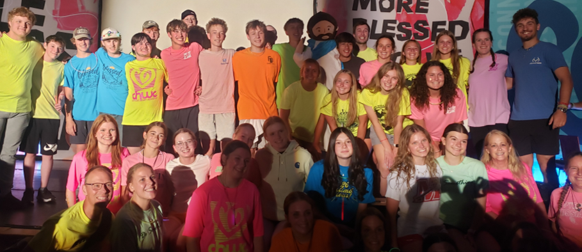
A youth participant shares their story.
St. Leonard parishioner delivering donations to St. Francis de Sales Seminary
December 8, 2025
Knights of Columbus Council #6448 and St. Leonard's Christian Formation program are pleased to announce that they donated $4,525 in gift cards and 95 gift bags to St. Francis de Sales Seminary through their collection in November 2025. This beats the previous record value of $3,344 in 2024. We express our heart-filled gratitude to our entire faith community, as this collection was made possible by the generosity of St. Leonard parishioners and all other individuals who donated. The annual Sentiments for Seminarians Collection seeks to help local seminarians supplement some of their basic needs with gift cards. Knights of Columbus Council #6448 explains, "Since seminarians don’t get paid, have no jobs or vacations, it’s often hard for them to obtain many simple, needed items and travel when and where they need to," ( read more on the Knights of Columbus webpage ).
October 24, 2025
October is the month dedicated to the rosary in the Catholic Church. It is a meditative prayer that helps us engage with the mysteries of Christ ( The Catechism of the Catholic Church #2708). The Church’s devotion to Mary does not replace or compete with adoration of God, rather, leads us to Christ through her inspiration and intercession ( CCC #971). Our school gathered for an outdoor rosary led by the sixth grade class, Fr. Pat, and parishioner Mary Dibb. Did you know that our older students pair up with younger class “buddies” for Mass and other prayers? What a great way to integrate faith, cooperation and leadership!
August 20, 2025
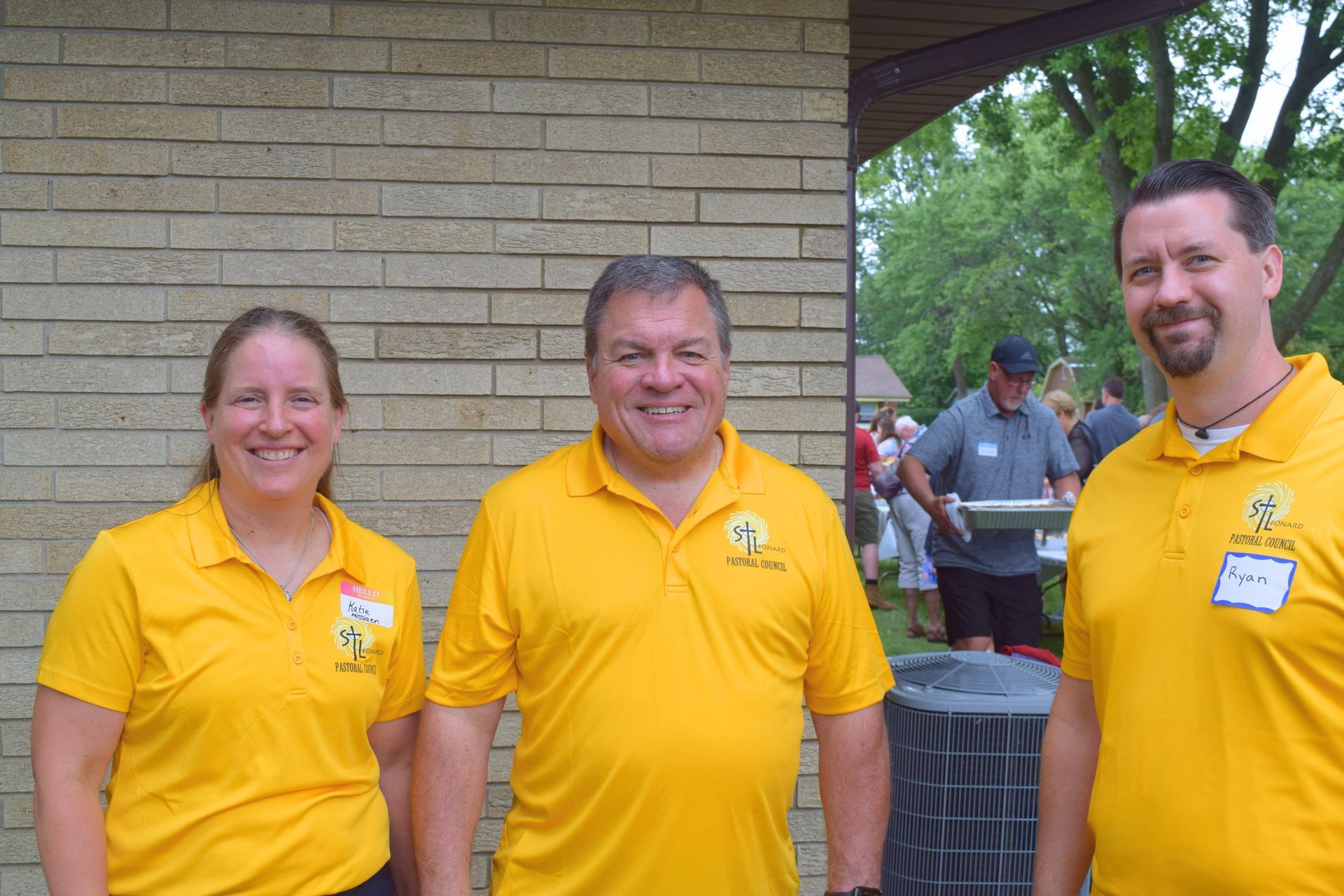
We had a great time at our annual parish picnic! Thank you to the Pastoral Council for hosting the event. Thank you also to parishioner Wes Niemcek and another anonymous parishioner for the photos. We can't wait to celebrate our faith community again next year!  Click the arrows to the left and right of the picture below to see our photo gallery.
August 12, 2025
We are pleased to report that our church building was not impacted by the flooding the weekend of August 9 and 10, 2025. We continue to pray for all those who were affected by the storms. In 2018 our church building flooded on Mother's Day. The Building & Grounds committee worked with an engineer to design and install mechanisms to prevent future flooding, including a gutter system to divert roof water to a retention pond on the Northeast corner of our property, a waterproof membrane along the West foundation wall and two new exterior sump pump crocks. We also excavated along the West wall to place gravel for a drainage trench. These improvements along with other repairs were made possible by many generous parishioners, including Pat Bartz, the Building & Grounds Committee– with special thanks to Bobby Schaefer, Len Roecker, Ray Jachimiec, Werner Holentunder, Bernie Cleppe, Phil Dibb and Charlie DuPont– and parishioners who contributed to the “Avoid The Ark” special collection.
July 24, 2025
We are pleased to report on the progress on our Summer construction projects. The new elementary library is complete:
By Fr. Augustine Shwe July 10, 2025
Fr. Augustine Shwe is the Mission Coordinator representing the Diocese of Mawlamyine, Myanmar  The Catholic Church in Myanmar (also known as Burma) is part of the worldwide Catholic Church under the spiritual leadership of the Pope in Rome. In 2020, there were approximately 700,000 Catholics in Burma- approximately 1.29% of the total population. The country is divided into sixteen dioceses including three archdioceses. Each of the archdioceses is also a metropolitan. There are over 1,000 priests and 2,000 nuns serving across 460 parishes. The Mawlamyin Diocese, established in 1993, covers the entire Taninthayi Region and southern Mon State, Myanmar with Bishop Raymond Saw Po Ray becoming its first residential bishop. Geographically, the diocese covers an area of 40,964 square kilometers and is home to a diverse population, including Burmese, Karen, Mon, Mawkin, Indians, Chinese, Siamese and Malays, practicing various religions such as Buddhism, Christianity, Islam, Hinduism and traditional beliefs. Between 1996 and 1998, military operations targeting insurgent groups affected much of the region, displacing many residents. This operation disrupted two-thirds of the villages, and resettlement efforts were slow, with some displaced people unable to return until 2011. After the diocese’s formation, several parishes were established and in 2008, the first diocesan synod was held during which the vision, mission, and planning for the future of the diocese were outlined. The synod focused on three main sectors: God, Social and Personal, emphasizing the importance of the three elements (3W)- the Word, Worship and Witness. The goal of our specific mission is re-strengthening the lives of our young people by providing integral education to promising students in the diocese. Since the military coup, Myanmar has been walking through darkness. So many lives have been broken, people have lost their homes, their work, their schools, their peace. Many now live as internally displaced persons (IDPs), without the security of a home or the comfort of stability. In this time of great pain, the Church is standing with the people not only praying for them but walking with them. One of the most urgent cries we hear is “Our children want to learn. But they have no way.” Many of our brightest and most gifted students can no longer study as their schools are closed and their families scattered. Their future, once full of promise, is now uncertain. It is heartbreaking to watch this happen. But we refuse to give up. That is why we are launching this important program. We want to bring education back into their hands and hope back into their hearts. We believe with all our hearts that youth are the hope of tomorrow. And we believe even more deeply that intelligent youth are the key to change. With the right education and formation, these young people can become leaders full of wisdom, courage and compassion, bringing peace where there is conflict, healing where there is pain, and faith where there is fear. They are the future of the Church, and they are the seeds of a new Myanmar. It is both a response to the urgent crisis and a strategic long-term plan to build a generation of strong, faithful and compassionate leaders. The goal of our program is to bring hope to displaced and conflict-affected youth by providing integral education and leadership formation, so they can rebuild their lives, serve their communities, and become the future leaders of the Church and nation. Our objectives To support the formal education of bright students affected by poverty, war, and displacement. To offer leadership and peacebuilding training to help them grow into responsible, wise, and confident leaders. To provide personal and spiritual formation, strengthening their values, faith, and compassion. To mentor and guide students with the help of Church leaders, teachers, and community members. To empower these youth as agents of change for peace, justice, and development in their own communities. Our main components of the program Educational Support: Tuition, school supplies, food, and basic needs for bright and struggling students. Leadership and Peacebuilding Formation: Training in leadership, peacebuilding, conflict resolution, and community organizing. Spiritual and Moral Growth: Retreats, formation days, and value-building sessions to nurture their faith and integrity. Mentoring and Community Engagement: Personal guidance from Church mentors and chances to serve their communities. Our expected impacts Displaced and poor students will have the chance to continue their education. A new generation of leaders with strong values will rise. These youth will become beacons of peace and development in broken communities. The Church will have faithful and capable leaders to serve with love and wisdom. Hope will return to the hearts of families and communities that now live in fear and loss. The current situation limits Diocesan pastoral works as the country remains in a state of political turmoil following a military coup in February, 2021, which ousted the democratically elected government. In the academic year 2024-2025, the diocese launched the “Good Shepherd” pre-Minor Seminary at the Diocesan Center, aiming to foster the development of local priests for the future of the church. The military regime continues to face widespread resistance from pro-democracy forces known as ethnic armed organizations (EAOs). Violent clashes persist across the country, with the military accused of severe human rights abuses, including mass killings and airstrikes on civilians. The economy is in crisis, and the humanitarian situation has worsened, with millions being displaced. Prospects for a peaceful transition to democracy remain bleak as the conflict escalates. We have great hope in these young people but know they cannot do this alone. This program is not only a response to today’s pain, but a vision for a better tomorrow. To support Fr. Augustine and his mission, envelopes are available in the kiosk in the Gathering Space or through their Giving Fuel website.
July 3, 2025
We are pleased to share another update on the construction projects taking place on campus this Summer.